
Supabet reputation: complaints, support and practical risk checks
 Available in AU

Contents
Australian decision guide
Supabet’s support offering includes live chat and email, but reputation is a separate question from whether those channels exist. For Australian readers, a useful reputation check separates verifiable product facts from user reports, ratings and unresolved complaints. Individual complaints can identify themes worth checking, but they are not proof that the same outcome will occur on another account.
Verifying Supabet Player Complaints, Support Quality and Risk Signals
Available sources identify live chat and email as Supabet support channels. That establishes contact routes, not service quality. Response speed, dispute handling and the outcome of a particular complaint can vary and should not be converted into a general claim without direct evidence.
A practical review therefore starts with the current terms, cashier conditions and account records. Save relevant chat transcripts and emails when a question affects verification, withdrawals or bonus conditions. Those records are more useful for an individual case than an aggregate star score.
How to read complaints without turning them into facts
Complaint pages and forum posts are user reports. They can reveal recurring topics to investigate, such as verification requests, withdrawal delays, bonus eligibility or communication problems, but the report alone does not establish why an event happened. Account-specific facts, omitted documents, promotion conditions and payment-provider checks can materially change the context.
Look for patterns across independent reports, then verify the underlying rule against the current terms or support response. Avoid treating one highly positive or negative account as representative of all users.
Three checks before relying on a reputation signal
| Signal | What it can tell you | What it cannot prove |
|---|---|---|
| Support channel exists | How the operator can be contacted | How quickly a future case will be resolved |
| User complaint | A problem someone says they experienced | That the same problem is systematic or will affect another account |
| Third-party rating | A publisher’s scoring method or user aggregate | An objective overall verdict on the operator |
Withdrawal and verification issues need account-level evidence
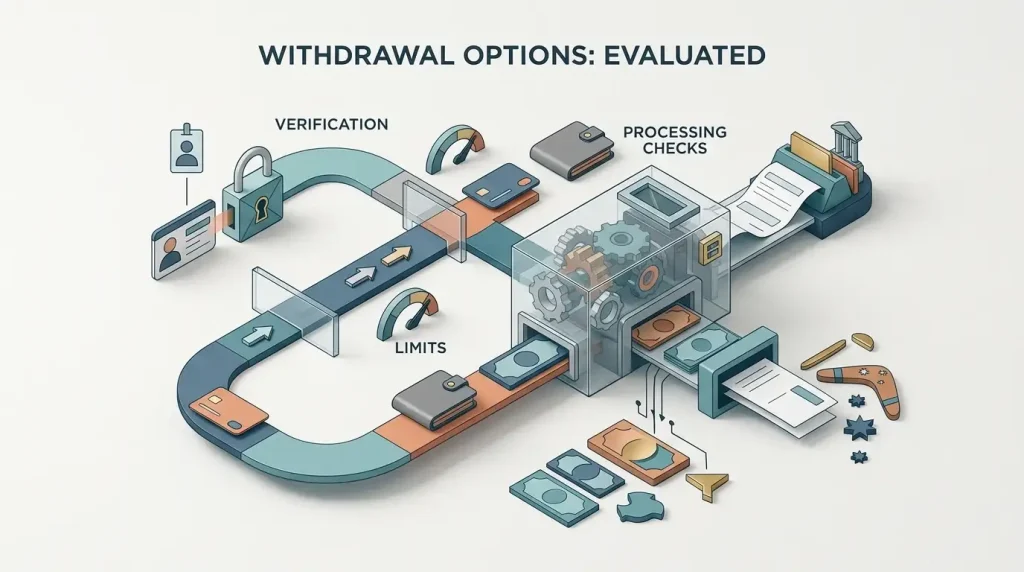
When a reputation concern involves cash-out or identity checks, use the dedicated Supabet withdrawal guide to separate general payment information from exact account conditions. Keep records of cashier messages and copies of support correspondence where appropriate, while protecting personal information.
The Supabet licence and Australian regulatory context page covers the separate legal question. A complaint record should not be used as a substitute for licence-register evidence, and licence status should not be used to infer how a particular support case was handled.
A practical support-record checklist
Before escalating a dispute, record the date, the transaction or promotion involved, the relevant terms visible at the time, and the response received through live chat or email. Keep the issue factual and specific. If support asks for verification, compare the request with the account instructions rather than relying on another user’s document list.
For broader harm-minimisation resources, see responsible gambling and Australian support options. For a site-wide decision sequence, use the Supabet Australia FAQ and decision checklist.
Assessing support and complaint information
A useful review of reputation checks should separate what can be seen now from what can change after an account is opened. The safest approach is to use the published information as a starting point, then confirm account-specific details in the live interface before relying on them. This avoids turning a general product description into a promise about one user, one payment method or one promotion.
Check quality of support responses
Look for quality of support responses in the place where it actually affects use of the service. Record what is displayed before committing money or accepting a promotion, and distinguish a current on-screen condition from a statement found in an older third-party review. If the information is absent or unclear, treat that as an unresolved point rather than filling the gap with an assumption. This keeps the comparison focused on evidence that can be acted on.
Check consistency of payment information
Look for consistency of payment information in the place where it actually affects use of the service. Record what is displayed before committing money or accepting a promotion, and distinguish a current on-screen condition from a statement found in an older third-party review. If the information is absent or unclear, treat that as an unresolved point rather than filling the gap with an assumption. This keeps the comparison focused on evidence that can be acted on.
Check clarity of terms
Look for clarity of terms in the place where it actually affects use of the service. Record what is displayed before committing money or accepting a promotion, and distinguish a current on-screen condition from a statement found in an older third-party review. If the information is absent or unclear, treat that as an unresolved point rather than filling the gap with an assumption. This keeps the comparison focused on evidence that can be acted on.
Check recurring complaint themes rather than isolated posts
Look for recurring complaint themes rather than isolated posts in the place where it actually affects use of the service. Record what is displayed before committing money or accepting a promotion, and distinguish a current on-screen condition from a statement found in an older third-party review. If the information is absent or unclear, treat that as an unresolved point rather than filling the gap with an assumption. This keeps the comparison focused on evidence that can be acted on.
Check whether a claim can be checked against first-party information
Look for whether a claim can be checked against first-party information in the place where it actually affects use of the service. Record what is displayed before committing money or accepting a promotion, and distinguish a current on-screen condition from a statement found in an older third-party review. If the information is absent or unclear, treat that as an unresolved point rather than filling the gap with an assumption. This keeps the comparison focused on evidence that can be acted on.
These checks do not require a positive or negative verdict on reputation checks. They are a way to reduce uncertainty: identify the feature, confirm the condition attached to it, and decide whether that condition works for the intended use. Where a term can change, the live Supabet page or account screen should take priority over a static description.
How to use Supabet reputation signals without over-reading them
Treat reputation material as a prompt for verification, not as a verdict. Confirm current terms, preserve your own account records, use the available support channels for account-specific questions and distinguish documented facts from attributed experiences. That approach gives Australian readers a clearer basis for assessing a specific issue without presenting individual complaints as established misconduct.
For the wider product overview, see the Supabet Australia review.
This material was created by the Supabet Australia Guide team.
Related posts

Supabet responsible gambling and Australian support options
Supabet withdrawals: verification, limits and processing checks